Counterfeit Electronic Components: A Hidden Risk in Industrial PCB Repair

In today’s technology and industrial world, electronic components are manufactured across many different countries and regions. Global manufacturing has made electronic parts more accessible and, in many cases, significantly less expensive.
Lower labor and manufacturing costs can make it possible to produce components at very competitive prices. There is nothing inherently wrong with a component simply because it was manufactured in a lower-cost region. Many reputable semiconductor manufacturers operate production facilities around the world.
However, there is another side of the electronic component market that industrial electronics technicians and PCB repair professionals need to take seriously:
Counterfeit, re-marked, recycled, and misrepresented electronic components.
In repair-shop language, technicians sometimes jokingly refer to crude re-marking as “potato stamping” — when a cheap, used, or completely different component is marked to look like a more valuable device.
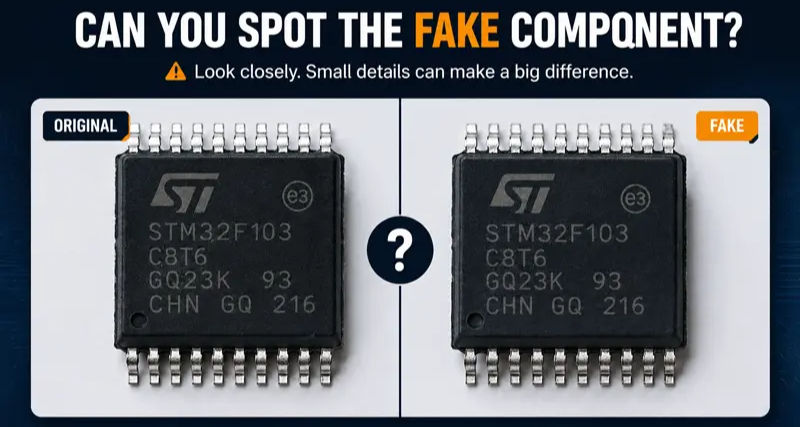
And sometimes, the fake looks surprisingly convincing.
What Is a Counterfeit Electronic Component?
A counterfeit component does not necessarily mean a completely fake semiconductor manufactured from scratch.
There are several ways questionable components can enter the supply chain.
A lower-cost semiconductor with similar basic characteristics may have its original markings removed and be re-marked with the part number of a more expensive component.
A used component may be removed from an old PCB, cleaned, refinished, re-marked, and sold as new.
In other cases, a genuine component may be represented as a different grade, revision, date code, or specification.
From the outside, the component may carry the correct manufacturer logo, part number, date code, and package style.
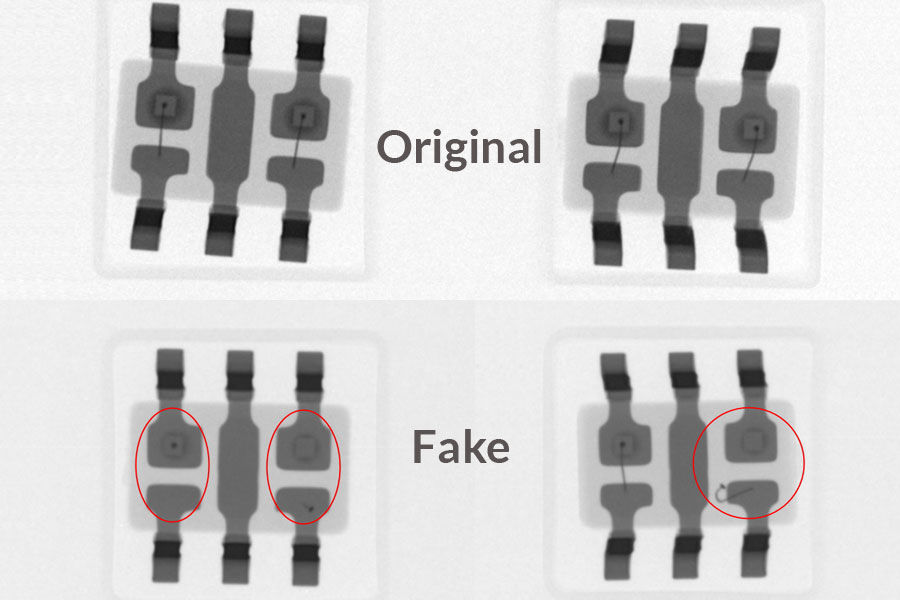
But what is actually inside the package may be something entirely different.
Why Counterfeit Parts Are a Serious Problem in Industrial PCB Repair
For a component-level repair technician, a counterfeit component is much more than simply a bad part.
Imagine troubleshooting an industrial control board.
After measurements and testing, you identify a semiconductor that appears to be defective. You order a replacement, install it, and power up the board.
The problem remains.
Naturally, you begin questioning your diagnosis.
Maybe another component is defective.
Maybe there is a problem somewhere else in the circuit.
Maybe you misunderstood how the circuit operates.
You can spend hours troubleshooting the board again.
But sometimes the original diagnosis was correct.
The replacement component was the problem.
This is one of the most frustrating situations in component-level electronics repair because the technician may begin troubleshooting his own repair rather than the original failure.
The Most Dangerous Counterfeit Part May Actually Work
A counterfeit or incorrectly re-marked semiconductor does not necessarily fail immediately.
That is what makes the problem particularly dangerous.
A component may pass a simple bench test and appear to operate normally under light load.
However, once installed in the actual equipment, it may be exposed to:
Higher current
Higher voltage
Elevated temperature
High switching frequencies
Repetitive electrical stress
Continuous industrial operation
The substitute device may have electrical characteristics close enough to the genuine component to operate temporarily but not close enough to meet the requirements of the original circuit.
A MOSFET, transistor, diode, voltage regulator, driver IC, or other semiconductor may therefore work during initial testing and fail later under real operating conditions.
For industrial electronics repair, this is often worse than receiving a completely dead component.
A dead component is relatively easy to identify.
An incorrect component that almost works can send the entire diagnostic process in the wrong direction.
Obsolete Components Are Where the Risk Becomes Greater
This problem becomes particularly important when repairing older industrial equipment.
Industrial machines are very different from consumer electronics.
A machine, controller, laboratory instrument, power supply, HVAC system, marine controller, automation system, or other industrial device may remain in operation for 10, 20, or even 30 years.
By the time its electronic board fails, some of the original semiconductors may have been discontinued for many years.

These are commonly referred to as obsolete components.
When the original manufacturer no longer produces the component and authorized distributors have no remaining inventory, technicians are forced to search the secondary market.
This is where the risk increases dramatically.
A semiconductor that originally cost only a few dollars may become extremely valuable simply because it is difficult to find.
That creates an economic incentive for someone to take a cheaper component in a similar package, remove its original markings, and print the identification of the rare component onto it.
Suddenly, a low-value semiconductor can be sold as a difficult-to-find obsolete industrial component.
Used Components Can Also Return to the Market
Counterfeit parts are not the only concern.
There is another category that technicians frequently encounter:
Recovered components.
Electronic components can be removed from old or discarded PCBs, cleaned, have their leads refinished or re-tinned, and then be packaged for resale.
After sufficient cosmetic work, a component that operated inside equipment for years can look remarkably similar to a new component.
This creates two separate questions for the technician:
Is this actually the component whose number is printed on the package?
And even if it is:
Is it really new?
Those are two very different questions.
A component can be completely genuine and still be used.
A genuine component removed from an old PCB is not automatically a counterfeit component. However, if that component is represented and sold as factory-new material, its history is being misrepresented.
How Can You Spot a Suspicious or Counterfeit Component?
Visual inspection alone cannot conclusively determine whether a semiconductor is genuine.
However, experience teaches technicians to recognize warning signs.
One of the first things to examine is the package itself.
Compare the physical package with known genuine examples and manufacturer documentation when possible.
The plastic texture, molding marks, edges, dimensions, surface finish, and overall construction should make sense for that manufacturer and component family.
Sometimes a suspicious component simply looks wrong.
And sometimes it looks very wrong.
Look Carefully at the Markings
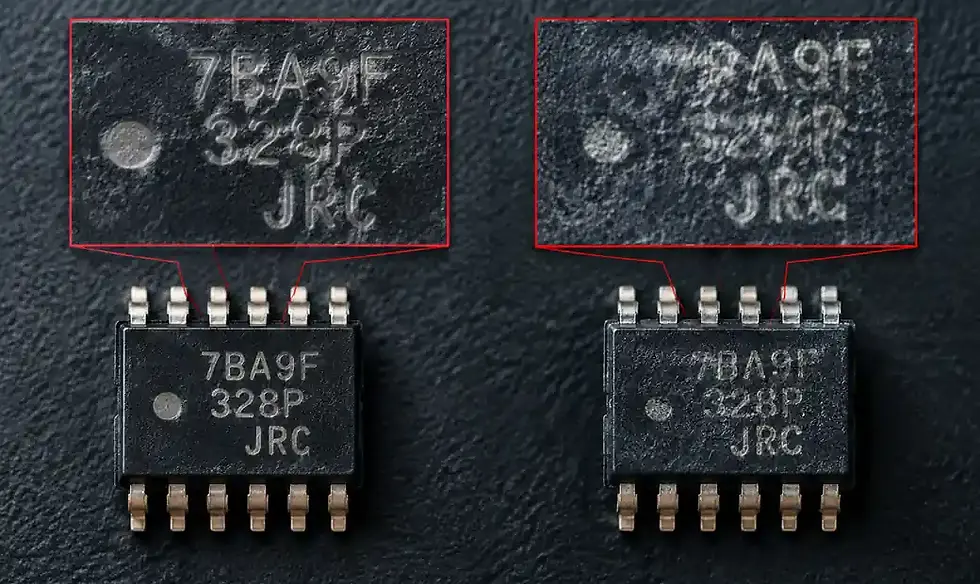
The printing or laser marking on the component can reveal important clues.
Look for:
Crooked or poorly aligned characters
Inconsistent fonts
Unusual spacing between characters
Different character sizes
Poor-quality printing
Incorrect manufacturer logos
Logos that only approximately resemble the genuine manufacturer's logo
Unusual date or lot codes
Different shades between the logo and part number
Markings that appear much newer than the package itself
The color and intensity of the markings can also be informative.
For example, if the manufacturer's logo has one appearance while the part number looks noticeably different in color, brightness, depth, or printing quality, the component deserves closer inspection.
This does not automatically prove that the component is counterfeit, because legitimate manufacturing processes can vary.
But it is a reason to investigate further.
Look at the Surface of the Package
Another technique used to disguise the original identity of a component is resurfacing, sometimes called blacktopping.
The original markings can be removed, the surface treated or coated, and new markings applied.
A technician examining the component under magnification may notice differences in:
Surface texture
Gloss
Color
Coating thickness
Areas around the edges
Mold marks
Small depressions or package features
Sometimes the top surface looks newer or different from the rest of the package.
Again, no single visual characteristic proves that a component is counterfeit, but multiple inconsistencies should increase suspicion.
The Leads Can Tell a Story
One of the most useful areas to inspect, particularly with obsolete components, is the leads.
Suppose you purchase a component advertised as new or unused.
Under magnification, however, you notice evidence of previous soldering.
The leads may show:
Remaining solder
Uneven tinning
Scratches from removal
Discoloration
Mechanical marks
Residue around the leads
Signs that old solder was removed
Evidence of re-tinning
That should immediately raise questions.
Components recovered from old boards can have their leads cleaned and re-tinned to make them appear new.
A good refurbishment job may remove most of the obvious evidence, but sometimes traces of the component's previous life remain visible.
It is important to make one distinction:
A used component is not necessarily a fake component.
It may be a perfectly genuine semiconductor manufactured by the company printed on the package.
But if it was removed from equipment after years of operation and is now being sold as new or unused, that is a completely different issue.
For technicians repairing valuable industrial electronics, the component's history matters.
Never Rely on One Sign Alone
A strange-looking logo does not automatically mean a component is counterfeit.
A slightly different font does not prove anything by itself.
Neither does a variation in package color.
Semiconductor manufacturers may use different factories, production periods, marking technologies, assembly facilities, or package revisions.
The important thing is to look at the combination of evidence.
For example:
Suspicious logo + unusual font + resurfaced package + questionable date code + evidence of previous soldering
is considerably more concerning than any one of those observations by itself.
When possible, suspicious components should also be compared with known genuine samples, manufacturer datasheets, package specifications, and electrical measurements.
Buying From a Trusted Source Matters
There is no simple way to eliminate counterfeit electronic components from the global supply chain.
For components that are still in production, purchasing from the manufacturer or established authorized distributors can significantly reduce the risk.
The situation becomes more complicated when the component is obsolete.
Sometimes there simply is no authorized source left.
A technician may have no choice but to purchase from the secondary market.
In those situations, the reputation and history of the supplier become extremely important.
An offer can also be suspicious simply because it does not make economic sense.
If a semiconductor that has been obsolete for 15 years and is extremely difficult to find suddenly appears from an unknown supplier in quantities of hundreds or thousands at an unusually low price, it is reasonable to ask questions.
The Lesson for Industrial Electronics Technicians
Component-level industrial PCB repair already requires considerable diagnostic work.
We analyze circuits, trace signals, measure power rails, test semiconductors, study datasheets, and try to understand why a circuit failed.
Counterfeit and misrepresented components introduce another variable into that process.
Sometimes you can correctly diagnose the circuit, correctly identify the failed component, correctly install the replacement — and still end up with the wrong result because the replacement part itself cannot be trusted.
That is why experienced technicians eventually learn an important lesson:
A component that looks new is not necessarily new, and the part number printed on the package does not always tell you what is actually inside.
And in industrial electronics repair, knowing where your replacement component came from can sometimes be just as important as knowing which component failed.
Zeki K. Bardakci
Industrial Electronics & Component-Level PCB Repair Specialist
PCB Tech USA | West Palm Beach, Florida



Comments